
Tuscan Red Wines
Updated: Jul 29
Chianti and Beyond: Red Wines of Tuscany
I love a good Pinot Noir. I also love a medium-bodied Malbec (from France or Argentina). In Italy, our Herbal Tuscany folks sampled a wide variety of wines grown in the limestone soil that is a hallmark of Tuscany and Umbria. (Our incredible journey Herbal Tuscany 2027 begins May 29! Get your registration in early.)
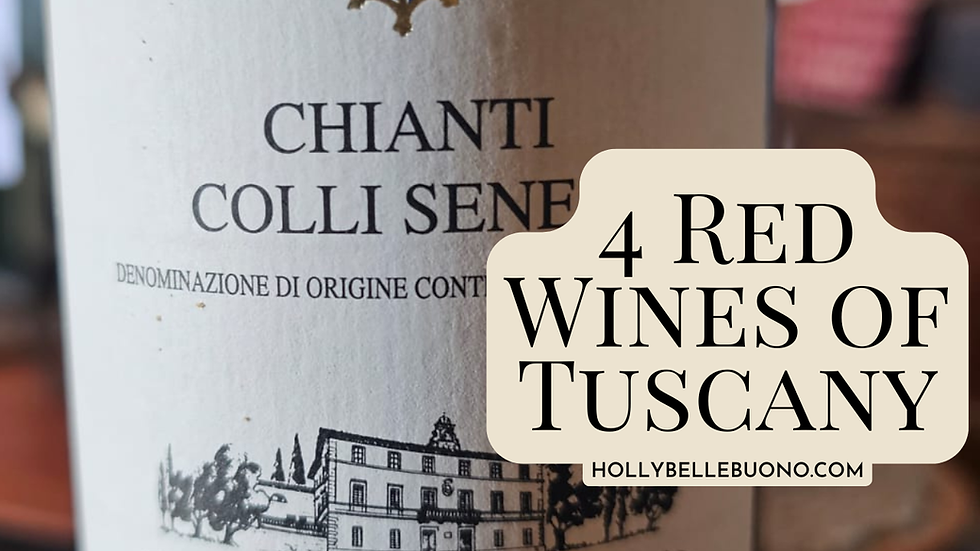
The photo above is of the lovely red chianti produced by Villa Certano, our home-away-from home during the Herbal Tuscany journey. It is a medium table wine with wonderful depth, and features a drawing of the estate's almost-castle on its label.
If France and Italy are diamonds in the wine-making world, Tuscany is the ruby, with wines that are as gorgeous as they are evocative. You’ll always find red wines served at table, whether for lunch or dinner or anytime in between. While Sangiovese is the queen of the region, Tuscany’s flavors are diverse—from rustic, historic blends to bold, modern tastes.
Join me next spring in Italy to sample and savor some of the country’s best reds:

Chianti Classico DOCG
My husband jokes that he never knew Chianti came in anything but a round-bottomed bottle wrapped in rattan. To him growing up in New England, that was Chianti, but for us—traveling to Italy in 2027—we will experience true Chiantis as we travel throughout the gorgeous mountainsides of the Chianti region of Tuscany.
The grape used to make Chianti wine is a minimum 80% Sangiovese, which gives a high acidity and strong tannin mouthfeel without being overbearing (like some Cabernets can be, imho). The flavor suggests red cherry, perhaps some balsamic, and hints of dried herbs. Cedar trees, linden trees, and hawthorn hedges line the meadows and farms of Chianti, so the grapes must pick up some of these characteristics, right? I don’t know, but as a gardener, that’s my guess.
By the way, DOCG is a government stamp signifying this particular wine has met Italy’s stringent requirements to carry the local label: strict growing parameters and location, approved grape varieties, strict aging requirements, and taste tests. When drinking these wines, you know you are indulging in true, authentic Italian viniculture.
Brunello di Montalcino DOCG
Chiantis are cherished on a daily basis, while smooth-talking Brunello is for special occasions. Produced around the fortress town of Montalcino, this wine is famous for meeting Italy’s strict aging requirements and for its longevity of flavor. Again, the grape is Sangiovese, but to carry the Brunello label it must be made with 100%, not 80%. In this region, the Sangiovese grape is called Brunello. It is required to be aged at least 5 years prior to releasing, giving it astonishing depth.
Vino Nobile di Montepulciano DOCG
Called noble, this wine is an ancient favorite of Italian popes and royalty. Here, the grape is known as Prugnolo Gentile which boasts a balanced, middle-of-the-red-carpet flavor of plums and cherries. It is a bit more refined than a deep, rich Brunello, and can be less expensive.
Bolgheri DOC (The "Super Tuscans")
Here, we get to the rebels. Instead of relying solely on Italian grapes, some renegades in the 1970s broke Italian custom (and law) to plant grape varieties from their neighbors: France.
The wines made from these hybrid varieties of grapes (Sangiovese blended with Cabernet Sauvignon, Merlot, Cabernet Franc, and Syrah) combine full-bodied flavor with vanilla and cedar notes and are known as Bolgheri wines. They are appreciated for their silky textures and dense fruitiness.
Food & Wine in Tuscany
All of these wines pair well with the tomato-tart pizzas served throughout the region, and with slices from a strong block of Pecorino cheese. They also pair well with roast lamb, duck breast, or truffle-infused dishes. We will consider ourselves very lucky to pair these wines with the incredible, melt-in-your-mouth Bistecca alla Fiorentina in Florence or with cianghale—wild boar, often served as a stew or in a tomato sauce over pasta. I ate lots of cianghale in Italy and loved every bite. It is heaven to pair it with any of the red wines on this list.
(And don’t forget, on our Herbal Tuscany 2027 trip, nearly all meals are already included, so we will indulge in the most delicious meals and wines.)
The International Herbal, Aromatherapy, and Plant-Lover's Retreat
Join us! Our Herbal Tuscany 2027 journey May 29 - June 11 will include the farms, food, wine, history, art, culture, gardens, fountains, and beauty of Tuscany and Umbria, as well as its iconic basilicas and cathedrals—strolls and meanders with edible and medicinal plants and the people who steward them, leaving us nourished and inspired.


Comments