

The Humble Journey of the Seed
Updated: Jul 29
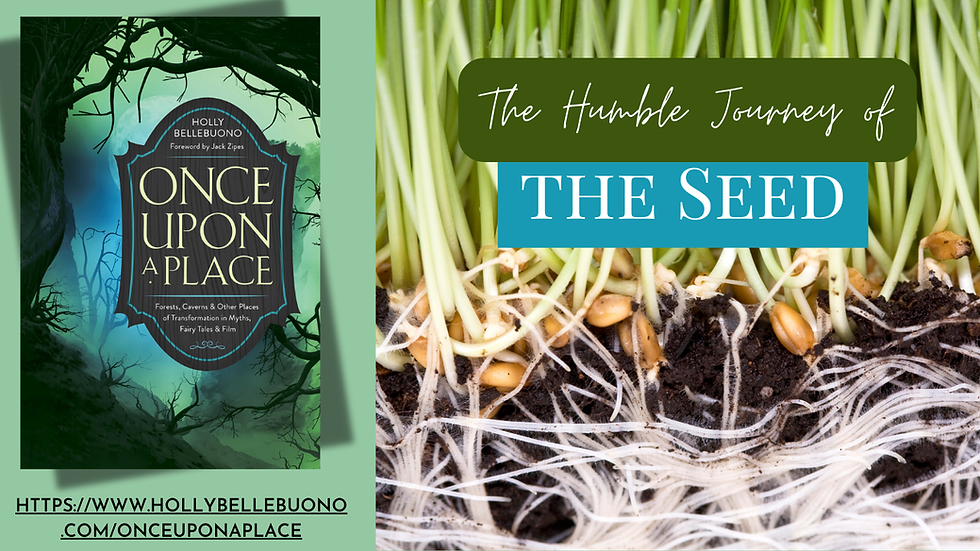
My herbal friends will easily recognize the story of the seed: unless it grabs onto the fur of a passing dog or deer, or it flies on the wind, it generally falls to the earth. Here, it nestles down into the dirt and spends the winter in the darkness. Come spring, it warms up and sprouts into the sunshine.
It’s a classic tale of descent-and-resurrection and it’s hardly seems more than a gardening metaphor. But the process is quite real, and writers have crafted hundreds of stories across cultures to expand upon this image so that readers understand their own personal changes.
Joseph Campbell’s Hero’s Journey
Joseph Campbell was a speaker and mythologist whose innovative work and personable style influenced an entire generation. As a professor at Sarah Lawrence College, he taught literature and especially how the myths of the world are related and their imagery is surprisingly similar. Until he showed this, most of us understood world mythology to be place-based or specific to a culture or region of the world, distinct from other myths in symbol and meaning.
But Campbell brought them all together into a symphony of imagery and common purpose and united the world’s stories in such a way that inspired, as he called it, the path to bliss.
Campbell also developed the concept of the Hero’s Journey, which has become the basis for many novels and films since he popularized the concept in the 1980s. Star Wars director George Lucas directly modeled his film and character arcs on Campell’s Hero’s Journey, which served as a process of step-by-step challenge and growth that a character needed in order to mature.
But there is more to the Hero's Journey: the landscape where change happens. For writers, this is the Setting or Sense of Place.
There is more that can be gleaned from these tales across time: the place.
In my book Once Upon A Place: Forests, Caverns, and Other Places of Transformation in Myths, Fairy Tales and Film, I look beyond Campbell's process to identify five key locations or landscapes where the action happens. If Campbell’s philosophy was a process (the HOW), my book shares the WHERE, guiding you through dozens of stories of quests, adventures and obstacles in which the location influences the character and the plot.
It’s a fun and meaningful way to look at stories we’ve heard since childhood and it shines a new light on the simple fairy tale phrase “into the woods.” Because the woods – the Forest – is a concept of chaos and void wherein we can easily get lost if we aren’t careful.
On the other hand, if we can create our own paths, our own structure, and overcome the metaphorical challenges (just like in real life), we will grow. Like a sapling. From a seed.
Writers, of course, must provide a robust and evocative Setting to their stories. Quests, epics, adventures and fantasy will use what I call Mythic Settings, while Literary Fiction, historical, commercial, YA, and even memoir will use Essential Settings. Learn more here.

Holly Bellebuono teaches Mythic Settings and Sense of Place for fiction writers, and leads writing retreats.
Her landmark book Once Upon A Place: Forests, Caverns and Other Place of Transformation in Myths, Fairy Tales and Film is the first to identify mythic landscapes used in fantasy writing and is available from your favorite bookstores and also as an audiobook. Click here for Holly's Speaker Sheet.


Comments